Wind Turbine Humanitarian Aid Mission
Overview
In creating a wind turbine customized for the specific energy needs of a remote and economically challenged town, we harnessed the power of AutoCAD Inventor to intricately refine the blade's design. Granta Edupack played a pivotal role in material selection, prioritizing locally available resources to enhance sustainability and bolster the local economy. Rigorous strength tests, facilitated by advanced testers, ensured the turbine's resilience under varying wind conditions. The design placed a strong emphasis on simplicity in manufacturing and maintenance, empowering the local community to handle repairs with minimal resources. This holistic approach not only sought to address energy challenges but also aimed to foster economic growth and self-sufficiency within the targeted region.
Reflection
In the wind turbine project, I focused on picking materials and testing blade thicknesses using
AutoCAD
Inventor. Granta Edupack helped me choose sustainable materials, though not from the local area. This
made me think a lot about finding a balance between sustainability and what the turbine needed to work
well.
As I worked on the design, each change made me ask new questions about how it would affect the
turbine's
performance and if it was good for the environment. I had to think about how the material I chose
would
impact the environment and if it was the right choice.
During testing, I questioned if the turbine could handle different wind conditions and explored other
options to make sure it would work well. I also thought about making the turbine easy to build and fix
so that the local community could take care of it without too much trouble.
In the end, the project turned into an ongoing conversation where I kept asking questions, considering
different options, and making sure the technology aligned with sustainability goals. It taught me a
lot
about the challenges of balancing technical and ethical aspects in engineering.
Design Process
-
1. Define the Problem:
- Design a simple, off-grid wind turbine for the Guatemalan village of Santa Cruz La Laguna, providing sufficient electricity for basic devices with minimal maintenance.
-
2. Material Selection and Conceptual Design:
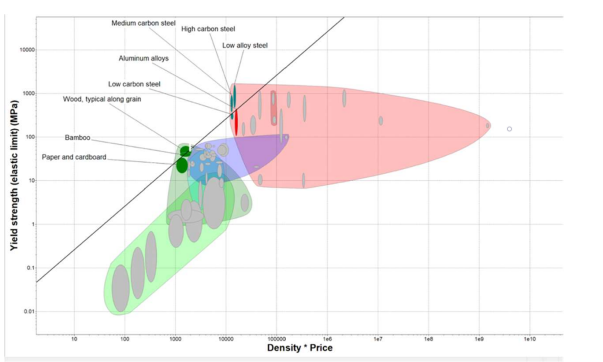
- Compared and contrasted properties of CFRP epoxy against alternatives using material property charts.
- Systematically evaluated materials with a decision matrix, considering factors like ease of access, corrosion resistance, maintenance, and wear resistance.
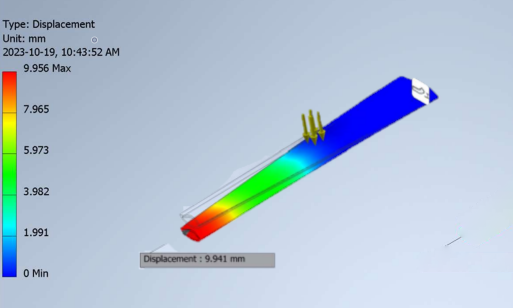
- Utilized CAD modeling to ensure the turbine blade's deflection remains below 10mm, aligning with the project's stiffness constraints.
-
3. Finalized Design:
- Chose CFRP epoxy based on its lightweight, durable, and corrosion-resistant properties identified through material property chart analysis.
- Utilized CAD modeling to confirm the ideal blade thickness of 53.33mm, meeting the stiffness constraints with a deflection below 10mm.
- Considered local conditions, emphasizing a design that suits the off-grid village's needs, promoting easy assembly and minimal maintenance.
Granta Material Selection Chart
AutoDesk Blade Deflection Simulation Test
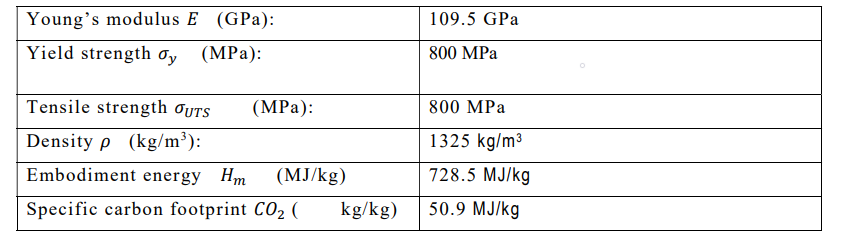
Material Properties of Chosen Material