Sorting And Recycling Containers
Overview
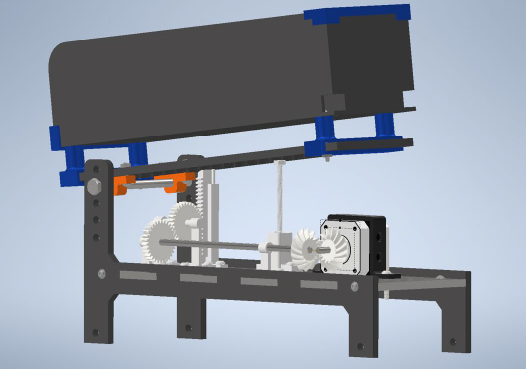
Utilizing AutoCAD, we meticulously engineered a sophisticated mechanism equipped with an actuator designed to effortlessly elevate the hopper and smoothly transfer containers into a bin. After completing the design phase, we employed cutting-edge 3D printing technology to manufacture all essential components, meticulously assembling them to create the final product. Furthermore, we programmed the Q-arm with precision, enabling it to adeptly manipulate various water bottles and position them onto the Q-bot's hopper. Subsequently, through meticulous refinement of the Q-bot's programming, we ensured seamless autonomous navigation along a predefined path, guaranteeing accurate placement of the water bottles into their designated locations.
Reflection
Being part of the team that designed and 3D printed the mechanism with the rotational actuator and gears
was an incredible journey. Using AutoCAD, we meticulously crafted each component, ensuring they worked
seamlessly together. Transitioning to 3D printing for fabrication was a game-changer, allowing us to see
our designs come to life with precision and speed.
As we assembled the parts, I couldn't help but feel a sense of pride. Every gear and rod was carefully
calibrated, knowing that our efforts would result in a mechanism capable of efficiently tilting the
hopper and transferring containers smoothly.
This project taught me so much about teamwork, problem-solving, and the importance of attention to
detail. Working with my peers, we leveraged each other's strengths to overcome challenges and bring our
vision to reality. It's a rewarding feeling to know that our work will make a difference in streamlining
operations.
Reflecting on this experience, I'm filled with gratitude for the opportunity to be part of such an
innovative project. The lessons learned and skills gained will undoubtedly shape my future endeavors,
driving me to continue pushing the boundaries of engineering excellence.
Design Process
-
Programming
1. Planning:
-Develop a high-level plan outlining the structure and architecture of the software
2. Created a Flow Chart and Wrote Pseudocode:
-Developed a visual representation of the program's flow.
-Drafted pseudocode for the three main functions: Pickup, Drop off, and Rotate.
3. Implementation of Core Functionality:
-Implemented the Pickup, Drop off, and Rotate functions based on the pseudocode.
4. Testing and Debugging:
-Conduct unit tests to ensure individual components function as expected -Debug and troubleshoot any issues or errors that arise during development. -
Modeling
1. Conceptualization and Planning:
-Brainstorm ideas and concepts for the model
-Develop a plan outlining the structure, features, and functionality of the model
2. Creation of Initial Models:
-Begin creating initial models based on the conceptual plan
-Use modeling software AutoCAD Inventor to make digital representations of the subject
3. Make a 3D Model:
-3D Printed all Parts and Assembled
4. Testing and Finalization:
-Conduct tests to ensure that the models meet functional requirements
-Finalize the models based on feedback and testing results.
Initial Drawing Prototype
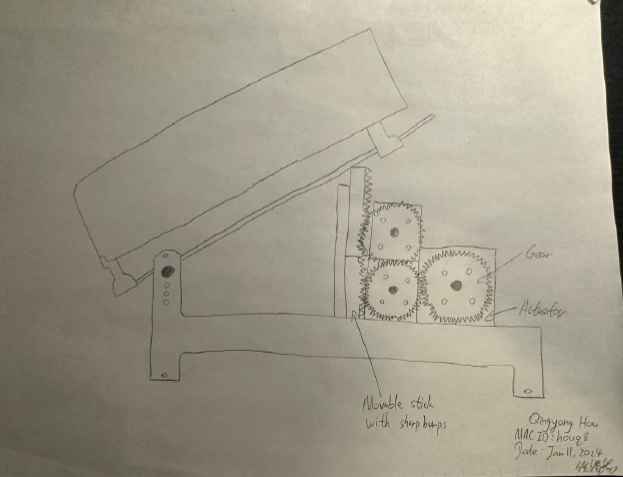
Final CAD of mechanism